Showing posts with label public relations. Show all posts

Monday, May 15, 2023

PR Is Finding and Telling Compelling Stories


As a member of the Twitterverse for 14 years, I always enjoy meeting new people and learning from them. One of my new connections is Bridgette Borst Ombres from Pittsburgh, Pennsylvania, and I invited her to appear here on my Blog in a Q&A about public relations and brand messaging. Highlights of our conversation follow a brief introduction.

A former TV news reporter turned PR and marketing professional with 15-plus years’ experience, Bridgette Borst Ombres left Corporate America during the pandemic and turned her side hustle into her main gig. Founder of The Commsultant, a boutique PR agency, Bridgette explains that B2B tech leaders and larger PR firms around the world hire her to consult on media strategy, thought leadership, and communications plans. Bridgette has media-trained more than 350 spokespeople and spearheaded communications efforts for a variety of companies from early-stage startups to large, multinational corporations. In addition, she is passionate about professional development, and over the years, has worked to place hundreds of students and young professionals in internships and jobs around the country.

QUESTION: According to Daniel J. Boorstin, “Some are born great, some achieve greatness, and some hire public relations officers.” As a PR professional, how do you interpret that quote?
BRIDGETTE BORST OMBRES: Every business leader and brand have a unique collection of experiences, distinct values, and attributes.

Savvy PR pros are naturally curious and skilled at peeling back layers to uncover the beauty, marvel, authentic, and relatable experiences in executives and brands. They’re gifted storytellers who can paint your true picture with words.

To me, PR isn’t about "dressing up" the mediocre or crafting an ingenuine message. It’s about sniffing out the compelling, untold stories or brand attributes and knowing which parts resonate most with which specific audience.

SHARE THIS: Savvy PR pros are gifted storytellers who can paint your true picture with words. ~@BridgetteBorst #PR #DebbieLaskeysBlog


QUESTION: What first attracted you to the field of public relations?
BRIDGETTE BORST OMBRES: I stumbled into a career in public relations and marketing while I was still working as a TV news reporter. I wanted more flexibility and creativity in my job, but still had a strong desire to keep my finger on the pulse of news, information, and storytelling. Through my network, I discovered I could earn my master’s degree in Integrated Marketing Communications online from West Virginia University. That terrific program introduced me to a wide range of marketing communications and job opportunities, including traditional public relations.

QUESTION: You were featured in an article for Business Insider entitled, “I cut my weekly work hours down from 70 to 20 after realizing the impact it had on my kid, and it's put me on a better career path.” Can you please share highlights?
BRIDGETTE BORST OMBRES: Leaving Corporate America six months into the pandemic to prioritize family and more flexibility has been one of the best decisions of my life.

The turning point for me to re-evaluate my priorities was when my toddler started imitating me on back-to-back Zoom calls. At that moment, I realized I wasn’t giving her the best version of myself and needed to make some changes. After transforming my side hustle in PR consulting into my primary source of income, I’ve maintained a much better work-life balance.

(Full article can be found here:
https://www.businessinsider.com/working-mom-cut-hours-quit-job-self-employed-best-decision-2022-3)

QUESTION: Please share your three favorite PR campaigns with reasons why.
BRIDGETTE BORST OMBRES: Airbnb.org’s Ukraine campaign was a great example of how brands stepped up to support refugees. Airbnb partnered with international and regional nonprofits and governments to secure housing for up to 100,000 refugees free of charge.

As a female founder and mother to a little girl, Mattel’s New Career campaign for Barbie and Dove’s Real Beauty campaign were both so powerful in spreading positive messages, fighting toxic beauty standards, and celebrating women.

QUESTION: How do you think public relations aligns with branding and social media?
BRIDGETTE BORST OMBRES: PR, branding, and social media all help shape the PERCEPTION of the business and share some of the same foundations such as research and writing. But, while PR and social are about managing key relationships, branding is centered on identity.

The lines between traditional PR and various areas of marketing have grown thinner and thinner. Today, communicators need to think more holistically to ensure that all promotional activities across the marketing mix are aligned.

QUESTION: What are your favorite brands, and why?
BRIDGETTE BORST OMBRES: I’ve been hard-pressed to find brands that deliver more consistent, quality products and service than Costco and Cover Girl.

My gratitude to Bridgette for sharing her public relations, brand storytelling, and messaging insights.

Connect with Bridgette at these links:
Twitter: https://twitter.com/BridgetteBorst
LinkedIn: https://www.linkedin.com/in/bridgetteborst

Image Credit:  OnyxRain.

Monday, March 20, 2023

PR, Storytelling and Brand Messaging


As a member of the Twitterverse for 14 years, I always enjoy meeting new people and learning from them. However, due to the chaos resulting from Elon Musk’s takeover of Twitter, I joined the Twitter exodus for a short time and joined Mastodon. One of my new connections on Mastodon is Christina Ferraz from Houston, Texas, and I invited her to appear here on my Blog in a Q&A about public relations and brand messaging. Highlights of our conversation follow a brief introduction.

Christina Ferraz is a high performance, flexible communication strategist, and adjunct professor with 20 years of experience. After matriculating with honors from Temple University with a Master of Science in Communication Management and awarded scholarships to present her research at the Popular Culture Association/American Culture Association, Christina grew her business, Thirty6five, with networks in New York City, Philadelphia, and Houston working with non-profits, small businesses, and public figures. Hispanic Public Relations Association awarded Christina with the Best Non-Profit Campaign for her work with Houston Ballet in 2022, and PRNEWS recognized Christina's work by awarding her Honorable Mention for the Pioneer Award in the CSR and Diversity Awards 2021. She has been quoted by The Washington Post, NPR, CNN, Houston Chronicle and has spoken on panels for to discuss the role of public relations in corporate social responsibility, marketing, and diversity, equity, inclusion, and belonging. She was also quoted in my post about 2022’s Brand Identity Changes – a link is provided at the end of this Q&A.

QUESTION: What three brands are handling their public relations campaigns exceptionally well during the Covid pandemic, and why?

CHRISTINA FERRAZ: TikTok is handling their public relations campaigns exceptionally well considering how US lawmakers view the platform as a security threat, because their parent company is based in China and want to ban the platform. TikTok’s popularity exploded during the Covid pandemic due to its videos depicting everyday life and replicable dance challenges. TikTok continues to grow and attract users as well as influence culture, so it will be interesting to see how they handle crises this year, and what they will do to remain dominant in social media if they are banned in the US.
 
I’m also impressed by Roc Nation and the NFL public relations campaigns in how they are using their strategic partnership to highlight Black artists and target Millennials. Last year, the Super Bowl Halftime Show featured Mary J, Blige, Dr. Dre, Snoop Dogg, Kendrick Lamar, 50 Cent and Eminem. The NFL was creative with how they had artists perform away from dancers on the field to respect social distancing among the Omicron wave in January. This year, the Super Bowl Halftime Show will feature Rihanna, an artist who once said that she would never perform for the NFL. Collectively, Roc Nation and the NFL show the importance of strategic partnerships and how keeping brands relevant by tapping into their target audience’s nostalgia is a clever strategy for success.
 
Walgreens is also a brand that handled public relations well during the Covid pandemic. In addition to managing marketing communications for vaccinations and testing, Walgreens was simultaneously managing crisis communications for its association with Theranos. Owned and founded by Elizabeth Holmes, Theranos was a privately-held health technology corporation that falsely claimed to own technology that could run several diagnostic tests using very little blood. They formed a partnership with Walgreens for these machines to be in their stores so they could expedite testing at a cheaper cost providing more access to the public. By focusing more on the marketing communications for vaccinations and testing, Walgreens was able to minimize blowback for their participation in what has now been called fraud by the SEC.

QUESTION: Due to all the chaos resulting in Elon Musk's purchase of Twitter, we met on Mastodon. How do you envision your use of Mastodon will be different than your use of Twitter?
 
CHRISTINA FERRAZ: I anticipate my presence on Mastodon to be much more about connecting with like-minded individuals where we can discuss numerous topics without the threat of violence or the proliferation of disinformation. I do not foresee Mastodon becoming part of my marketing funnel for my company, Thirty6five, so I believe that Mastodon will allow me to be more observant and supportive of other creatives while sharing/boosting their thoughts to my followers. I think the biggest difference between my use of Mastodon and Twitter will be the amount of writing I will do when speaking on PR crises. Twitter did not have enough characters to write extensively about any topic without linking to another website or social platform to read more.

QUESTION: What inspired you to join the field of public relations?

CHRISTINA FERRAZ: I’m a former journalist, so I’ve always been drawn to telling stories – it’s my passion. I found that public relations allowed me to focus more on writing and provided me with a variety of experiences I wasn’t privy to working in radio and TV. I realized I enjoyed bringing attention to brands and entrepreneurs making a difference in their communities and improving the lives of others. It’s incredibly rewarding to support these leaders and help them reach their targeted audiences to get the attention they deserve. I also love managing crises. Creating crisis communication responses that both inform the public and protect brands is thrilling!

SHARE THIS: I’ve always been drawn to telling stories. ~Christina Ferraz #DebbieLaskeysBlog

QUESTION: In an article for NPR, you said, "Trust with [a] brand is what's going to make [consumers] invest in the brand." With that said, how do you align public relations with brand marketing?

CHRISTINA FERRAZ: Building trust with consumers requires a consistent approach to public relations such that media placements, crisis responses, and strategic partnerships build an identity that aligns with brand marketing. What you say is just as important as what you do -- and what you say you’ll do -- and in that way, public relations and marketing need to be in lock-step in the formation of brand identity and tone when it comes to media mapping and marketing campaigns.

Additionally, corporate social responsibility has become more important in recent years, most especially with Gen Z consumers, and responding accordingly to crises lends to the importance of brand reputation. Social media allows for both the documentation of a brand’s history and instantaneous reactions that can immediately reach millions of people.

A thoughtful approach to public relations and brand marketing is important in building trust by maintaining a positive brand reputation that convinces consumers to invest in that brand.

SHARE THIS: Building trust with consumers requires a consistent approach to public relations. ~Christina Ferraz #DebbieLaskeysBlog

QUESTION: According to Laura Holloway, Founder and Chief of The Storyteller Agency (@StorytellerAgcy on Twitter), “Storytelling is our obligation to the next generation. If all we are doing is marketing, we are doing a disservice, and not only to our profession, but to our children, and their children. Give something of meaning to your audience by inspiring, engaging, and educating them with story. Stop marketing. Start storytelling.” What does this quote mean to you?
 
CHRISTINA FERRAZ: I appreciate this quote by Laura Holloway because it is the same approach I take with public relations. The difference between marketing and storytelling lies in the way a brand values its consumers. If you only see consumers as a sale to make instead of human beings connecting to hear the difference/sameness in our stories, you will be talking AT people instead of TO people – and people hate being sold. To me, this quote means that storytelling is greater than marketing, and to be successful in communications is to ENGAGE WITH your audience instead of JUST SELLING TO your audience.

QUESTION: What are your three favorite brands, and why?

CHRISTINA FERRAZ: Here are my three:

I am a fan of Coca-Cola because of their approach to branding – from design to marketing to strategic partnerships. Coca-Cola demonstrates a level of consistency and global reach most brands will never achieve. Their brand identity revolves around family which is a universal theme by which any culture can relate.
 
I also support Lush Cosmetics because of its commitment to recycling, fair trade practices, advocacy, and philanthropy, refusal to test on animals, and global presence that influences them to create products reflective of the local culture in addition to their evergreen campaigns and products. I especially like their brand consistency because no matter where you are in the world you can recognize a Lush Cosmetics store with its black packaging, white script, and tongue-in-cheek marketing.
 
Lastly, I have a great deal of respect for Nike and its commitment to diversity, equity, and inclusion. From groundbreaking campaigns with celebrities like Michael Jordan to creating adaptive clothing for people with disabilities, Nike is a case-study on the ways in which consumer feedback influences branding. Social listening can be incredibly helpful in helping a brand to remain relevant, and Nike demonstrates how social listening can contribute to the longevity and success of a brand.

My gratitude and appreciation to Christina for sharing her public relations and messaging insights.

Image Credit: Debbie Laskey.

Quote featured on Debbie Laskey’s Blog:
“2022 Was the Year of #BrandIdentity Changes”
https://www.debbielaskeysblog.com/2023/01/2022-was-year-of-brandidentity-changes.html

Article referenced in first question’s response:
“Lawmakers are trying to ban TikTok. That won’t be easy – it’s part of our culture now”
https://www.cnn.com/2023/01/07/us/tiktok-ban-culture-cec/index.html

Article referenced in final question’s response:
“Nike launches hands-free shoes inspired by man with cerebral palsy”
https://disabilityhorizons.com/2021/02/nike-launches-hands-free-shoes-inspired-by-man-with-cerebral-palsy/

Connect with Christina at these links:
Website: www.thirty6five.com
LinkedIn: www.linkedin.com/in/theprprofessor
Instagram: @theprprofessor
Mastodon: https://techhub.social/@christinaferraz

Tuesday, August 16, 2022

The Intersection of Public Relations and Personal Branding

Today is an important day for music fans all around the world because it's Elvis Presley Commemoration Day. Without a doubt, Elvis made his mark on rock and roll music, pop music, and films - and also on publicity, public relations, marketing, and personal branding. So, as Elvis Week is celebrated in Memphis marking the 45th anniversary of the King of Rock and Roll's death, let's take a look at the intersection of public relations and personal branding.

To quote Matthew Kobach (@mkobach), "Twitter is a key that unlocks thousands of doors, some of which you never even knew existed." As a member of the Twitterverse for almost 13 years, I always enjoy meeting new people and learning from them. I recently connected with Anu Bhatnagar and invited her to appear here on my Blog in a Q&A format. Highlights of our conversation follow a brief introduction.

Anu Bhatnagar is based in the United Arab Emirates. She has over 20 years of experience as a strategy expert, publicity and communications consultant, content creator, author, contributing writer, ghostwriter for CEO's and thought leaders, entrepreneur, and NGO mentor. Connect on Twitter @AnuMeera2024.

QUESTION: What's your favorite aspect of public relations?
ANU BHATNAGAR: One thing that I truly love about my work as a publicity advisor is to discover the potential value in a person, a concept or a service. Then, using my ability to articulate this through written words, in different ways, and in different styles that resonate with different set of larger communities. I see this as my contribution to society, especially when I work with exceptionally-gifted individuals, who have so much to give to the world and I become a channel through which they are able to reach others and share their value.

QUESTION: What's the most successful PR campaign you've created, and why?
ANU BHATNAGAR: One of the largest and first public health awareness campaigns in the United Arab Emirates was known as Diabetes Knowledge Action. I led public outreach, creating powerful messages for a range of audiences; news pieces on workplace health for CEO’s to interactive stories on how to choose healthier breakfasts for children in schools. I penned a book of healthier recipes and managed to get the campaign featured in over 1,000 publications.

I rate this as my most successful campaign because of the huge impact we were able to create, including normalizing the conversation about diabetes and obesity in the community and setting families on a path toward a healthier lifestyle.

This also became a turning point in my life, personally and professionally. Public health, community health, and healthcare are one of my core expertises today. I am very active in public health advocacy and am a menstrual health campaigner. I designed my very unique lifestyle coaching program to integrate well-being and food and nutrition as essential components.

QUESTION: What is the secret to successful personal branding?
ANU BHATNAGAR: Here are three secrets:
(1) Know your ‘self’ truly and then envision how you want to show this unique and powerful ‘self’ to the world and why. Let your authentic essence be the foundation of your personal branding from the start.
(2) Make your evolution a part of your personal branding strategy and don’t hide your growth, your growth lessons and your evolution to create an ideal larger than life image. Let your community see these changes and grow with you.
(3) Cultivate a mindset of “being happy and comfortable with showing your authentic self” and rise above your resistance, fears, and imposter syndrome, known and unknown, to you. This unconditional acceptance of ‘self success’ will make the journey more effortless, enjoyable, and real for you.

TWEET THIS: Let your authentic essence be the foundation of your personal branding from the start. ~@AnuMeera2024 #PersonalBranding #DebbieLaskeysBlog


QUESTION: What three famous individuals have memorable personal brands, and why?
ANU BHATNAGAR: Here are three:
(1) Richard Branson for his ability to stay candid and authentic – no matter where he is.
(2) Ayushmann Khurrana, an Indian actor, a maverick, multi-talented person, a singer, and poet. He weaves his personal style, fashion, his “feminist man” personality, social causes, and creativity all very beautifully into his brand. (https://www.instagram.com/ayushmannk/)
(3) Matthew McConaughey is a classic and an example of what I explained earlier: make evolution a part of your personal branding. He has evolved and is not afraid to take his followers and community with him as he grows.

QUESTION: In your Twitter profile, you list several hashtags including these two: #WomenInPolitics and #GenderEquality. This leads me to ask, what is your favorite quote from former Supreme Court Justice Ruth Bader Ginsburg, and why?
ANU BHATNAGAR: This quote was published in The New York Times in 2009:
“I always thought that there was nothing an anti-feminist would want more than to have women only in women’s organizations, in their own little corner empathizing with each other and not touching a man’s world. If you’re going to change things, you have to be with the people who hold the levers.”

This was so meaningful and futuristic at that time, but the sad reality is that it is still true and wanting in 2022.

I love this quote for three reasons:
(1) It calls out the “token women” syndrome.
(2) It calls for inclusion of women in ‘power and decision making roles’ because that is what it will take this world to become an equal world.
(3) Women must be at every table where policies, decisions, and such conversations are discussed. Mechanism and systems can either include or exclude women, and we need systems that make it possible for more women to enter, rise, and lead places where decisions are made.

QUESTION: Janet Yellen, the current and first female Secretary of the United States Treasury, has been described as, "A proven leader who knows how to build consensus, the kind of person who makes everybody around her better." What three characteristics are necessary to create a consensus-builder?
ANU BHATNAGAR: Here are my three:
(1) Ability to create a collective vision, something that will inspire community.
(2) Empathy that makes every person feel seen and heard.
(3) Self motivation that makes you wake up every day and go on doing what it takes to realize your vision.


My thanks to Anu for sharing her PR, personal branding, and gender equality insights and for appearing here on my Blog.

Image Credit: Redd via Unsplash.

Tuesday, March 1, 2022

Is Your Brand Ready for International Women's Day?


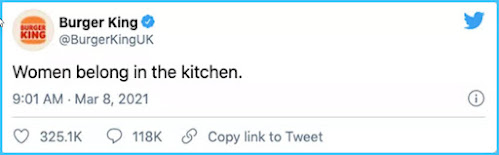
As International Women's Day, March 8, approaches, is your brand ready? Have you created a unique ad campaign or a new product launch to celebrate women and women's achievements? If not, there's still time. No matter what you do, however, do NOT repeat what Burger King did last year. Allow me to refresh your memory.

As Lisa Roberts wrote for PR News:

"Five simple words: “Women belong in the kitchen.” One cringe-worthy tweet. Hoping to deliver its International Women’s Day campaign, Burger King UK instead made headlines for a controversial marketing choice. The public reacted swiftly. It called out the fast-food giant for using a sexist trope as clickbait. Highlighting gender disparity in the restaurant industry was the campaign's aim. That got lost in the hubbub. It didn’t take long for Burger King to backpedal. The company deleted the tweet and apologized for its insensitivity. It explained the intent of the provocative post, but the damage was done. In less than a day, women’s rights activists were speaking out against Burger King."

According to Daniel Piper of CreativeBlog:

"If you're wondering how Burger King's marketing team managed to convince itself this was a good idea, the company tried to explain in subsequent tweets. "Only 20% of chefs are women," one read. "We're on a mission to change the gender ratio in the restaurant industry by empowering female employees." The company said it was launching a new scholarship program to help female Burger King employees pursue their culinary dreams.

Later in the day on March 8, Burger King UK deleted the tweet and explained its reasoning in a separate Twitter post. "We hear you. We got our initial tweet wrong and we’re sorry," it began in one tweet. A second tweet read: "We decided to delete the original tweet after our apology. It was brought to our attention that there were abusive comments in the thread, and we don't want to leave the space open for that."

Burger King wrote in a statement: 

“We are committed to helping women break through a male-dominated culinary culture in the world’s fine dining restaurants, and sometimes that requires drawing attention to the problem we’re trying to help fix. Our tweet in the UK today was designed to draw attention to the fact that only a small percentage of chefs and head chefs are women. It was our mistake to not include the full explanation in our initial tweet and have adjusted our activity moving forward because we’re sure that when people read the entirety of our commitment, they will share our belief in this important opportunity."

The bottom line is this: If you are taking the time and spending the money to create a marketing campaign, spend time in the early stages and research who it will reach, what their core values are, and what may upset them. Look at how these targeted stakeholders engage online, things they talk about, language they use, accounts they follow, and causes they support. Then, and only then, go live with your campaign - not before.

And if you need a lesson from a positive marketing campaign, travel back seven years to what has affectionately been called the ice bucket challenge. The ALS Association, a nonprofit organization, raised $115 million to fund research with a simple challenge: Get a bucket of ice and water and record pouring it on someone. More than 17 million videos including posts by Bill Gates and George Bush were shared with the #IceBucketChallenge hashtag during the summer of 2014.

What have you learned from these two examples to help your brand's future marketing, advertising, and public relations campaigns?


Image Credit: The now-deleted tweet via Future.

Monday, October 25, 2021

The Importance of Reputation Management

Over the last 12 years, thanks to social media, I have had the privilege of meeting a myriad of amazing marketing, branding, customer experience, leadership, and social media experts. One of these experts is Craig Badings from Australia. We recently discussed reputation management, corporate culture, and crisis management, and highlights follow Craig's bio.

Craig Badings has spent over 30 years advising major corporations and senior executives in Australia and South Africa on their reputation in good times and bad. Much of that time has been spent working in the trenches with boards, management teams, and in-house communication teams assisting them with issues and crisis preparation and management, media coaching and media relations, communication strategy, social media strategy, and thought leadership. Craig is also the author of two ebooks and two published books on thought leadership. Follow on Twitter at @ThoughtStrategy and connect on LinkedIn at https://www.linkedin.com/in/craigbadingsthoughtleader/.

QUESTION: How do you define "reputation management?"
CRAIG BADINGS: Reputation management revolves around three things: context, stakeholders, and culture. To protect and enhance a brand or a corporation’s reputation, that entity needs to have a strong handle on the context in which it is operating and specifically how it's key stakeholders view that context and how it impacts their lives, their decision making, and their perception of whether the brand is operating within or beyond its social license.

You can have the best reputation management practices in place, but if your culture does not align with your values nor your purpose, your organisation’s risk exposure is dramatically increased. Over three decades, almost all the crises in which I have been involved have stemmed from poor culture or a breakdown of what was done versus the values or purpose of that organisation.

(Read more on this topic by Craig in his post: Avoiding the post-pandemic culture chasm:
https://senateshj.com/insight/learning-from-disruption-3/)

TWEET THIS: If your culture does not align with your values nor your purpose, your org's risk exposure is dramatically increased. -@ThoughtStrategy #CorporateCulture #EmployeeExperience #DebbieLaskeysBlog


QUESTION: You recently wrote about three types of response to a crisis. Can you share brief highlights?
CRAIG BADINGS: There are three types:
(1) The Ostrich – they bury their heads in the sand hoping it will blow over or subside. Some companies purposefully employ this strategy, but it can be high risk on two fronts; 1) the news, social media and public sentiment can run away from you very quickly and grow increasingly negative and sometimes hostile; 2) the company can be accused of trying to hide things, ducking their responsibility and being irresponsible or intransigent in their response.
 
(2) The Pugilist – the company goes on the attack and comes out swinging punches, i.e., legal letters, statements and social media responses which are very defensive in nature and tone, reacting too quickly, denying things without really knowing the full facts, not showing empathy nor offering an apology, ignoring the context, saying or doing things (or not doing things) which can result in a secondary crisis, or which further inflame the situation.

(3) The cool, calm and collected – they have the plans, the necessary structures as well as crisis experienced people in place inside and outside the organisation. They’ve also tested them in some form of crisis simulation. They respond quickly but in a measured, empathetic way and always with a broader understanding for the context. They realise who their stakeholders are, how and when to communicate with them every step of the way, and they take control of the narrative. They balance advice from communication consultants and their lawyers – they don’t hide behind the law but realise that a well-placed, authentic apology, and the right empathetic tone can help enormously in managing how they are perceived to be handling the crisis.

QUESTION: Can you name three CEO’s who have stepped up following a crisis, and what did they do?
CRAIG BADINGS: Here are my three:

(1) The Whole Foods Co-CEOs Walter Robb and John Mackey when accused of overcharging customers sent out a video message in which they fully accepted responsibility. Said Robb: "Straight up, we made some mistakes. We want to own that and tell you what we’re doing about it."
(2) At the start of Covid-19, Marriott International CEO Arne Sorenson said he would forfeit his salary for the year and that Marriott would donate hotel rooms to front-line workers to help fight the pandemic. He also asked executives to sacrifice half their salaries.
(3) In 2018, two African American men were arrested for trespassing at a Philadelphia Starbucks while waiting for a friend. Starbucks CEO Kevin Johnson travelled to Philadelphia to meet the arrested men and announced he would close all 8,000 US stores for half a day so that about 175,000 employees could attend racial bias education to address implicit bias and prevent discrimination. Johnson’s communication was also spot on: "I want to offer a personal apology to the two men who were arrested in our store. What happened in the way that incident escalated and the outcome, was nothing but reprehensible, and I am sorry...Now there’s been some calls for us to take action on the store manager. I believe that blame is misplaced. In fact, I think the focus of fixing this: I own it. This is a management issue, and I am accountable to ensure we address the policy and the practice and the training that led to this outcome."

QUESTION: In your book, Brand Stand, you described seven steps to thought leadership. Can you share highlights?
CRAIG BADINGS: When I wrote that book, I spent a year researching what had been written about thought leadership. I was amazed to find there was nothing outlining a process or methodology to arrive at a thought leadership position. Most of it was how to take your thought leadership to market, the content, the channels.

That prompted me to come up with a five-step process:
(1) Understand the challenge, i.e., the biggest issues facing your stakeholders and the objectives for your thought leadership.
(2) Develop the thought leadership strategy, i.e., do the research (you need empirical evidence), allocate internal resources including senior management buy-in.
(3) Content development and production, i.e., develop your collateral, coach your spokespeople, and launch internally first.
(4) Launch your thought leadership communications program, i.e., build a pervasive presence with your stakeholders (depending on who they are, this could include media, social media, events, etc., but it must be relevant to the way your stakeholder’s consume content).
(5) Measurement, evaluation, and recalibration, i.e., measure against your original objectives and then make the necessary changes - the best thought leadership is built over years and is not a one-off.

QUESTION: There is an important alignment between reputation management and public relations. In March 2021, Burger King experienced a PR crisis, and you commented with the directive, “Know your audience.” Can you elaborate?
CRAIG BADINGS: What I was saying is that you cannot afford to be tone deaf to the context in which you operate. You run a huge reputation risk to your brand if you aren’t tapped into monitoring environmental, social, and governance (ESG) issues. At its core, this means knowing what they are and understanding how your stakeholders feel about these things. Companies which sometimes hide behind the mantra of their legal right are often defensive or naïve.

Look where it got Rio Tinto, who was legally entitled to blow up the Juukan Caves, but it was a decision so out of kilter with stakeholder and societal expectations that it resulted in a huge crisis for the company and the loss of jobs for many senior executives. Read more about the Juukan Cave destruction in my article in PR Week: https://www.prweek.com/article/1706949/juukan-cave-destruction-red-light-pr-practitioners.

The role of PR practitioners has changed. It's no longer good enough to only think about content, media, and selling the benefits of your brand. Instead, PR is a lot more all-encompassing and should be focused on the entire gamut of reputation management.

In our experience at SenateSHJ, this revolves around three key areas: Promotion, Engagement, and Protection. Here is a bit more on each of those:
(1) Stakeholder engagement: executive visibility/profile-building program, thought leadership, CSR (Corporate Social Responsibility) communication, proactive media and government relations, social media and content marketing.
(2) Engagement: employee engagement and communication, culture change, leadership behaviour programs, behavioural programs, and change management.
(3) Protection: crisis preparedness, crisis management, issues tracking, stakeholder engagement, alignment with other corporate risk frameworks, e.g., BCP (Business Continuity Planning).

TWEET THIS: The role of PR practitioners has changed. It's no longer good enough to only think about content, media, and selling the benefits of your brand. -@ThoughtStrategy #PR #DebbieLaskeysBlog


QUESTION: What are your three favorite brands, and why?
CRAIG BADINGS: Here are my three:
(1) Fenn surfskis: First, because I am a surfski nut and get out paddling on the water on Sydney’s beautiful harbour waterways as well as the ocean off Manly Beach. Second, because they are made in the country where I grew up, South Africa, and every ski purchased supports local employment in a country suffering from high unemployment.
(2) Apple iPhone: The only time I ever completely missed my train stop going home from the city was when I got my first iPhone. I was so engrossed in the incredible features, apps, and the user friendliness of it that I went a few stops past mine. It remains my favourite piece of tech in my life.
(3) Patagonia: I read founder, Yvon Chouinard’s book, Let My People Go Surfing, many years ago well before ESG (environmental, social, and governance) and sustainability was fashionable. I was struck by their strong sense of purpose and their values right from the outset.

My gratitude to Craig for appearing on my Blog and for sharing his inspiring marketing and reputation management insights.


Image Credit: Debbie Laskey.

Friday, April 29, 2016

Five #PR Lessons from the Kelly and Michael Drama

Recently, the on-air talent for the morning television show “Live! With Kelly and Michael” experienced some unwanted publicity. A change in personnel was announced, and very unexpectedly, the two stars BECAME the news. ABC apparently informed Kelly about Michael’s departure from the show just minutes before the public announcement. Naturally, Kelly was upset and angry and opted out of appearing on the daytime talk show for four days. Upon her return, the two presented a united public face, but there may be tension behind-the-scenes. As a result of this public drama, we can all learn some valuable lessons about public relations.

LESSON ONE – PLAN HOW TO COMMUNICATE NEWS

Think about Kelly’s complaint about being blind sighted by the news announcement. Whether you work in a mom-and-pop store, a small business, or a nonprofit, how news is communicated can be just as important as the news that is being communicated. Therefore, assemble the people who will be most impacted by the announcement and share the news one-on-one. Let people digest the news and answer all questions at that time before announcing the news to the entire company – or to the public.

LESSON TWO – FOCUS ON TIMING

Was ABC’s announcement made at the best possible time? When you plan a significant announcement for your business, consider the day, the time, and the month. It might be best to make an announcement at the end of a month or the end of a quarter. Perhaps, your business has reached a financial milestone, so an announcement makes sense at that time. But whatever decision you make, implement a timing strategy for your announcement.

LESSON THREE – FOCUS ON CLARITY

Think about the content of ABC’s announcement
– a change in personnel hasn’t happened too often over the years, so it was bound to attract media coverage – but certainly not the HOW and WHEN of the announcement. When a new announcement is made, employees and the outside community often look at the announcement by placing it in context with your company’s past news announcements and/or product/service launches. Therefore, does the latest announcement seem in line with the direction of the company, or does it seem like it came out of left field? Don’t confuse your audiences or stakeholders.

LESSON FOUR – EAT CROW
Think about how Kelly took a few days off to think about her reaction. She then returned to the show with a smile on her face. If unexpected things happen upon making a public announcement, your executive or leadership team must be prepared to admit a lack of judgment or erroneous information. They need to be comfortable in front of a camera and dealing with members of the media. Your company’s future could be at stake, so your media preparation is critical.

LESSON FIVE – AVOID SOCIAL MEDIA
Immediately upon hearing the announcement, many social media channels lit up with the hashtag #KellyandMichael with all types of comments. Upon hearing unexpected news, don’t immediately rush to your favorite social media platforms. Remember that once something is posted to the Internet, it takes on a life of its own, and you cannot take it back or delete it. Therefore, keep your comments to yourself. If you have to tell someone, tell yourself in a mirror at home – not to the receptionist at your workplace – and definitely not on Twitter or Facebook.

Lastly, remember that everything your business does is in some way reflected outside your workplace walls. Even if you run a small business or small nonprofit, you have an audience, customers, constituents, and stakeholders. Since you want your news announcements to be met with a positive reaction, think strategically before publicizing your news to avoid as many surprising reactions as possible.

Sunday, March 15, 2015

What Happens When PR and Social Media Intersect?


I would like to introduce Jayme Soulati to my blog. Jayme is president of Soulati Media, Inc., and a message mapping master. She offers blended public relations marketing with content, social, digital, and internet marketing. Recently, she launched a podcast, The Heart of Marketing, on iTunes and Stitcher Radio, and since 2010, she’s been an award-winning blogger. She’s also a past president of the Publicity Club of Chicago. Follow her on Twitter @Soulati and on her website (http://soulati.com). We recently talked about the intersection of social media and PR, and highlights of our conversation follow below.

QUESTION: As a social media strategist, how do you integrate social media into an overall marketing plan to create consistent messaging?
JAYME SOULATI: Social media marketing is hunkering down as just another tool. The excitement has dulled with the intense evolution of Facebook as a publicly-traded entity, monetization demands across the channels, and the expected demise of Google Plus. That’s not to say we can ignore social media! It needs to be included in the blended marketing plan as a method of amplifying messages consistently and sharing owned media. Regardless of how you’re pushing messages and where, it is critical that social media marketers use approved brand messages across all media for accuracy, clarity, and consistency.

QUESTION: What are the five ways PR can benefit from social media, and why?
JAYME SOULATI: As a seasoned PR professional, I understand the value of writing across media. You need to become a change artist as social media writing is an art form! Showcase writing talent with tweets. IMHO, tweets provide the toughest writing opportunity as the message gets portrayed succinctly.

Every PR person has to develop a personal brand. Back in the day, that was a buzz phrase, and today it remains important. Developing a professionally strong identity via social media is an opportunity – seize it!

Networking has always been the core of business and professional development. Do use social media to engage with others you’d like to meet, from whom you’d like to learn, and make the ask! Most of us are always interested in helping others in our profession.

Knowledge immersion can be overwhelming and social media provides astonishing opportunity to get free knowledge from the best sites. If there’s time to dive in deeply from the A-listers and the sites with specialty topics, seize it! More carpe diem!

Career advancement is probably the least used avenue in social media for PR peeps. It’s pretty rare that I get someone to nicely stalk me in social channels or ask my help looking for a position. I love that! People should be more aware of finding their peers because genuine connections can be made.

QUESTION: What’s your favorite social media platform, and why?
JAYME SOULATI: Twitter remains my favorite channel by far. I guess it’s the immediacy of the connectivity, the speed conversations occur, the global reach, and the ‘raderie I’ve built on this channel. It’s where I earned my social media mojo in early 2009, and it truly saved my life from a dismal relocation to a new city where I knew no one. Back in the day during the great recession, we partied on Twitter every night. It was a banterfest, and that’s where I made my earliest and deepest connections with peeps around the world. I relish the early days and miss them, too.

QUESTION: There was a post last year indicating that the most important word in marketing is relevance. How did that post impact your marketing? 

(http://www.socialmediaexplorer.com/advertising/the-one-word-your-marketing-needs-to-focus-on-now)
JAYME SOULATI: I’d argue that relevance is directly aligned with authenticity. If you present your brand authentically, you build trust. The relevance quotient goes up a notch when you realize that people are reading you, engaging with you, and sharing your content because you’re being smart and relevant.

People need to learn how to cut the clutter and differentiate. Relevance is learned behavior, and for folks to stand out in the social media circus, they need to continually innovate and change with the technology disruption. Pretty soon humans will be irrelevant; I’m seeing the signs all over from driverless cars to watches that pay your bills. We need to work hard at being authoritative so customers regard us as relevant.

QUESTION: Lastly, in today’s social era, it’s critical to create personal brands. You have branded yourself as a “message mapping master.” How do you describe this, and how do you use it as a tool to stand out?
JAYME SOULATI: When you reach the point in your professional development with a breadth of ticked-off accomplishments on the checklist, then it’s time to explore specialty services. People have a difficult time knowing how to open the door to work with an accomplished professional.

By rebranding as a message mapping master, I’ve been able to pinpoint a service most companies need. With the leadership team together, we hash out a huge free think about the company. Every detail is explored, and using the conversation as inspiration, I can craft a messaging suite that better clarifies the company’s services, products, people, mission, customers, and more. The simple and clarified messaging is used to write a website, case studies, social media, blogging, thought leadership, and more.

My gratitude to Jayme for sharing how her concept of “message mapping” can create more memorable brands when the worlds of PR and social media intersect.