Showing posts with label public speaking. Show all posts

Monday, September 26, 2022

Storytelling, Connections, and Social Media

To quote Matthew Kobach (@mkobach), "Twitter is a key that unlocks thousands of doors, some of which you never even knew existed." As a member of the Twitterverse for 13 years, I always enjoy meeting new people and learning from them. I recently connected with Gail Robertson from Ontario, Canada, and invited her to appear here on my Blog in a Q&A format. Highlights of our conversation follow a brief introduction.

Gail Robertson brings an unfamiliar and fresh outlook to the more traditional manufacturing industry. She has always been curious, which led her into journalism. She began her professional career as a journalist at the Toronto Star and has worked at The Hamilton Spectator, The St. Catharines Standard, and The Windsor Star. She now uses storytelling, developed as a journalist, in the manufacturing world as a social media strategist and keynote speaker, helping others to #ShowUP, tell their story, and exercise their curious brain. Her transferable skills have assisted her as she transitioned from being a journalist, to bed-and-breakfast owner, to fundraiser, to marketing manager at an insurance tech company and now, as “Chief Curiosity Officer” at GailNow.

QUESTION: What first attracted you to marketing, communications, PR, and storytelling?


GAIL ROBERTSON: Growing up, I loved to hear stories and was especially enamored by their development, one sentence at a time. To me, marketing, communications, and PR are related as they help a company or brand tell their story.

I also love to connect with people, and after years as a journalist and now Chief Curiosty Officer, I  realize how many stories are not being told!

Meeting people and helping tell and share their stories is exciting and powerful as I believe we can change the world, one story at a time. I know far too many women who also are reluctant to own their power and step into the spotlight.

TWEET THIS: Meeting people and helping tell their stories is exciting...we can change the world, one story at a time. ~@GailNow #brandstorytelling #DebbieLaskeysBlog


QUESTION: On your website, it says, "Gail's true joy and passion for networking and connecting with others is what makes her a top motivational speaker." What tips do you have for people who may share your passion for connection but lack your confidence in public speaking?

GAIL ROBERTSON: My tip for them would be to embrace their own story and speak from that. As American author and professor of literature, Joseph Campbell, once said, “You are the hero of your own story.”

We also need to look at our own individual comfort zones and not compare ourselves to others. For public speaking, it is also about taking baby steps and realizing we have a duty to “show up,” not just for ourselves but for others. We have a duty to share stories!   

Some of the best speakers aren’t extroverts, but they had to start with the right mindset and decide to challenge themselves. Even the best speakers struggle with Imposter Syndrome and fear of failure, so it’s best to embrace failure and make it your friend!

Very few people find public speaking easy - even the ones who make it LOOK easy. It takes an incredible amount of time, hard work, and practice. The best tip is to just start. Speak up in a meeting or at your local church or school. Speak up online too. Join a video challenge! Get comfortable being uncomfortable, as cliche as that sounds. By just deciding to start, you are so much further ahead than others sitting on the couch. As a keynote speaker, I still get nervous; I worry and I stress about my content, which is normal. But the more I share stories and get feedback, the more supported I feel to Sign Up, Suit Up, and Show up!

QUESTION: What's your favorite social media platform, and why?

GAIL ROBERTSON: Twitter: it’s fast-paced, has a greater diversity of content, and is an excellent way to meet, get to know, and engage with people. It is also a place you need to curate content and embrace the scroll button. I have met phenomenal people through Twitter, including Nathalie Gregg who leads the #LeadLoudly Twitter Chat.

Along with great connections, there are some other top notch Twitter Chats like #USAMfgHour and #TwitterSmarter. You can find a chat for just about any topic. There is also audio. With Twitter Spaces, you can jump in, listen, and meet incredible people.

While Twitter still is a “favorite,” each social media platform has its own special place in my heart! I like a few others for different reasons and have also connected with cool people. For sure, LinkedIn is phenomenal, and I have even started enjoying the fun part of TikTok.  Social media is what you make it, and with some engagement and sharing of content and ideas, each platform can deliver results.

TWEET THIS: Twitter is an excellent way to meet, get to know, and engage with people. ~@GailNow #connections #DebbieLaskeysBlog


QUESTION: You wrote an excellent article on your Blog entitled, "When You're Ready for Your Close-Up, Mr. DeMille." (On a side note, I'm a film buff, so I really enjoyed the post.) Can you provide an overview that explains the tie-in between the film and marketing?

(Read the post here: https://gailnow.com/2021/when-youre-ready-for-your-close-up-mr-demille/)

GAIL ROBERTSON: In the film, Norma Desmond realizes she has to adjust to the times in order to continue making an impact. Similarly, in today’s world, we need to adjust to the times (for example, video is required to make an impact).

Video is extremely powerful when it comes to getting your message across. According to Oberlo.ca, 87% of marketing professionals use video as one of their tools, and whether they pop up on YouTube, Instagram, Twitter, Snapchat, or any other social media platform that allows more than just posting a pic, it’s a key way to sell your product or service through your most valuable asset – you.

So when we look at film, it is all about building relationships via the big screen. Today, we can use video and tell stories; showing a part of your personality AND building relationships by allowing people to get to know you. Films are still powerful, and now we can add to that power with social media, through video and sharing behind-the-scenes clips, by sharing insights about stars in a film. AND, social media posts with film and video content get 48% more views than those without them, according to HubSpot.

So, bottom line, video footage featuring your employees, customers, and/or volunteers is a great way to make them feel part of the action. And there is also great ROI: A single film/video can be repurposed for different lengths, platforms, and audiences. That ONE video can return a great deal back to you!

My thanks to Gail for sharing her digital marketing insights and for appearing here on my Blog.

Image Credit: Reuben Juarez via Wordswag.

Monday, July 18, 2022

Tips to Avoid Extra Noise When Speaking in Public


To quote Matthew Kobach (@mkobach), "Twitter is a key that unlocks thousands of doors, some of which you never even knew existed." As a member of the Twitterverse for almost 13 years, I always enjoy meeting new people and learning from them. I recently connected with John Bowe and invited him to appear here on my Blog in a Q&A format to talk about public speaking. Highlights of our conversation follow a brief introduction.

Based in New York City, John Bowe is the award-winning author of I Have Something to Say: Mastering the Art of Public Speaking in an Age of Disconnection (Random House, August 2020). He is a speech and presentation consultant specializing in corporate and individual presentations; and has worked with entrepreneurs and executives from all over the world, as well as students, activists, and charity leaders. John contributes regularly to CNBC about public speaking and has written for The New Yorker, The New York Times Magazine, and GQ, among other magazines, and is the author, editor, and co-editor of numerous books. His work has been featured in the Harvard Business Review, The New York Times; and he has appeared on CNN, The Daily Show, with Jon Stewart, the BBC, and many others.

QUESTION: In your cover image on Twitter, you wrote, "I have something to say - mastering the art of public speaking in the age of disconnection." Can you please explain?
JOHN BOWE: While working as a journalist, not a speech or communications expert, I accidentally discovered that speech training accomplishes what many people seek through psychiatry, therapy and meds. It teaches people the mental and verbal techniques for connecting to others. It’s a simple technical skill, but it has a huge emotional payoff.

I followed my curiosity and discovered Toastmasters, which led me to the ancient Greeks and Romans who invented speech training. In their own pre-scientific way, they’d found this amazing way of educating people to interact and socialize better than we normally know how to do without training. The payoff was huge for individuals, but it also had a beneficial effect on society. Speech training became the core subject of higher learning for 2,000 years, the key skill for anyone planning to work in an organization. And now we don’t learn this stuff, and shockingly, people don’t know how to connect very well with one another. I put our lack of speech training at the root of modern speech anxiety, isolation, partisanship, lack of trust on every level, and it suddenly looks like a potential remedy for a lot of modern problems in America and everywhere else.

QUESTION: Why do you think most people fear public speaking?
JOHN BOWE: People fear public speaking for the same reason that they fear flying airplanes, because they’ve never been taught to do it. I think most of us ascribe it to some kind of mental or psychological problem. “I’m speech anxious.” “I’m shy.” The problem is me. It kills me that we don’t teach speech in school anymore. Ten hours of education, and I think at least half of all people would get over half their problems with public speaking. Once you see it as an art form that you can learn, it lifts a huge emotional burden. It’s actually relatively easy to learn.

QUESTION: What is the most common error that people make when speaking in public?
JOHN BOWE: People want to seem smart when speaking to a group. So when we get on stage, the Zoom call, the job interview, etc., we tend to rattle off a bunch of facts and data and slides and blah blah. And it’s boring. And disconnected. And the talk ends, and no one feels very good or enlightened or smart.

The best way to be smart in public speaking is to be clear, focused, brief, and relevant. It’s counter-intuitive for modern people, but thinking about who you’re talking to - and why - is the primary plane of focus. Facts come afterwards. It’s the easiest thing in the world to figure out, but it’s so obvious, most people can’t see it.

TWEET THIS: The best way to be smart in public speaking is to be clear, focused, brief, and relevant. ~@JohnFBowe #PublicSpeakingTips #DebbieLaskeysBlog


QUESTION: You wrote a post for CNBC entitled, "Avoid These 5 Types of Words and Phrases that Make You Sound 'Immature.'" Can you provide a recap?
JOHN BOWE: My definition of public speaking comes from Aristotle, so it’s weird by modern standards. Public speaking basically just means translating your thoughts from inside your brain to the world outside. Whether you’re talking about small talk or a TED talk, the same principles apply. It’s all about paying attention to your audience and their needs.

To a degree, the root of authority comes from being able to give people the information they need without constantly, unconsciously inserting yourself. And immaturity is kind of the opposite.

When you talk too much about yourself or water down your message with tics, you seem unprofessional. If you repeat stuff with your mouth that you’re already displaying on your slides, you’re wasting people’s bandwidth. When you use too many filler words like, “you know” or indulge yourself in too many unnecessary asides – same deal. Making apologies like, “Oh my god, this deck is such a mess. I’ve been so busy. My mother-in-law was visiting” – you’re just presuming someone wants to hear it in the middle of their busy day! Business jargon, “low-hanging fruit” and all the rest — it doesn’t make you look smarter; it makes you look pretentious.

So, as always, it really comes down to being able to give people what they need without a lot of extra noise.

(Read the full post here: https://www.cnbc.com/2022/02/14/avoid-these-words-and-phrases-that-make-you-sound-immature-says-speech-expert.html)

TWEET THIS: Give people what they need without a lot of extra noise. ~@JohnFBowe #PublicSpeakingTips #DebbieLaskeysBlog


QUESTION: Which three people alive today inspire you with their public speaking presence, word choice, and delivery?
JOHN BOWE: Dave Chappelle, Michelle Obama, and Oprah. This isn’t a racial commentary. I just don’t know of anyone else who comes close to them.

QUESTION: When I was in graduate school two decades ago, a guest speaker did something memorable. He taped a ten dollar bill to the wall at the front of the room. As people entered the room, their eyes were drawn to the money, and everyone wondered why the bill was on the wall. Once the speaker began his presentation, he explained that there was a typo in one of his slides, and the first person to catch the typo would get the ten dollars. Everyone paid attention to the presentation and read the slides. And one student got the ten dollars. What are some secrets you'd like to share?
JOHN BOWE: Visuals are powerful. People often remember them even if they forget the rest of a talk. But I think the only way to find those visuals is to focus on the basics first. If you really, really hone the purpose of your talk, whatever it is, and you organize your ideas really clearly, you’ll find great visual ways of demonstrating your ideas as you practice. I think the same is true for humor.

My thanks to John for sharing his public speaking insights and for appearing here on my Blog.

Image Credit: Giulia May via Unsplash.

Visit John's links:
Website: www.johnfbowe.com
Twitter: www.twitter.com/JohnFBowe
LinkedIn: www.linkedin.com/in/johnfbowe/

Monday, April 4, 2022

Want Some Public Speaking Secrets?

To quote Matthew Kobach (@mkobach), "Twitter is a key that unlocks thousands of doors, some of which you never even knew existed." As a member of the Twitterverse for almost 13 years, I always enjoy meeting new people and learning from them. I recently connected with John Zimmer and invited him to appear here on my Blog in a Q&A format. Highlights of our conversation follow a brief introduction.

John Zimmer is an internationally-recognized speaker and expert on public speaking and presentation skills. Originally from Canada and now living in Switzerland, he gives keynotes, moderates events, and helps companies, organizations, and individuals communicate more effectively. Before becoming a full-time speaker, John worked as a lawyer for a major Canadian law firm, the United Nations, and the World Health Organization. John is a 9-time District champion of Toastmasters public speaking contests; a TEDx Speaker; and the co-creator of Rhetoric, The Public Speaking Game, the world’s first public speaking game. In addition, John writes a popular blog about public speaking, Manner of Speaking (www.mannerofspeaking.org), one of the leading blogs in the field of public speaking, presentation skills, and communication. Connect on Twitter @ZimmerJohn.

QUESTION: On your blog, you wrote a wonderful post entitled, "Three Lessons from the Island of Corfu." It was appropriately themed for your area of expertise, public speaking, because you emphasized "knowing your audience." What were some of the other key take-aways?

(Read the post here: https://mannerofspeaking.org/2021/08/07/three-lessons-from-the-island-of-corfu/)

JOHN ZIMMER: I always look for insights and inspiration from unlikely sources, so the three lessons were drawn from a dinner reservation, a Greek salad, and two kittens. People can read the post for the full details, but the key take-aways include the power of simplicity in a presentation, the importance of great content, and perhaps most importantly, the fact that there is room for you to speak in public. Many people think that to be able to speak in public, you must be an extrovert or have a certain type of style. Nothing could be further from the truth. Everyone is unique; embracing that uniqueness will help you be authentic on stage. As Oscar Wilde said, “Be yourself, everyone else is already taken.”

QUESTION: What are the three most common mistakes people make when giving speeches?
JOHN ZIMMER: There are a lot more than three, and it varies from person to person. Nevertheless, here are three that I see often:

(1) Trying to convey too much information. This usually results in confusion and lack of clarity. You are much better off saying less but saying it well.

(2) Speaking too quickly on stage. I understand that the adrenaline is going, and people get nervous. I still get a bit nervous after all these years. But you need to slow down and pause from time to time so that the audience can keep up with you.

(3) Terrible slides full of text. I don’t think I need to say much more on this point because we’ve all seen it.

QUESTION: How can people overcome the three most common mistakes when giving speeches?
JOHN ZIMMER: My advice below relates to each of the points in the previous question.

(1) Start by being clear as to the message you are trying to convey and why the audience should care. List all the possible things that could support the message, but then limit yourself to the most important. Don’t try to cover everything. If there is more that the audience needs to know, tell them and then say that, in your talk, you will discuss two (or three or four) things of particular importance. Remember that a presentation is not the same thing as a detailed document - they have different purposes.

(2) Become comfortable with silence when you are on stage. This means that you must learn how to pause for a few seconds now and then. Especially after you make a key point. Pausing while speaking has two powerful benefits. First, you look good to the audience. The Iranian poet Rumi said, “When I am silent, I have thunder hidden inside.” You are not going to be intimidated by the silence or by the fact that everyone is looking at you - people will respect that. Second, when you pause, you give the audience a chance to think about and digest what you have just said. If you speak too quickly, your ideas become pressed up against each other and it is harder for the audience to follow you.

I have written about the importance of pausing when speaking in public, when to do it, and how to do it in this post entitled, "Pauses in a speech: Why, when and how - Manner of speaking."

(Read the post here: https://mannerofspeaking.org/2019/11/12/pauses-in-a-speech-why-when-and-how/)

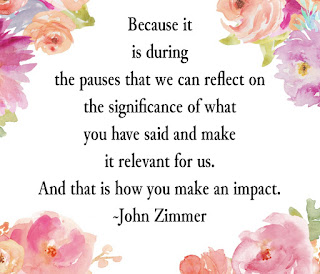
TWEET THIS: Because it is during the pauses that we can reflect on the significance of what you have said and make it relevant for us. And that is how you make an impact. ~@ZimmerJohn #DebbieLaskeysBlog


(3) Most slides should be like the sign beside the highway as you are driving along at 100 kph (62 mph). You have about three or four seconds to look at the sign, get the information you need, and get your eyes back on the road. It’s the same with slides. The audience should be able to look at the slide and understand it quickly and then refocus on you. If you put too much information on the slide, you force the audience to make a choice: it’s either you or the slide. So less is more. Give each idea its own slide. And never use slides as your speaking notes! If all you are going to do is read your slides, you can save us all time by turning the slides into a PDF and sending them to us.

QUESTION: Which three people alive today inspire you with their public speaking presence, word choice, delivery, knowledge, etc.?
JOHN ZIMMER: I am going to cheat with the first one because he only passed away recently: Sir Ken Robinson. He was a gifted educationalist and speaker. Everyone should watch his first TED Talk on how schools kill creativity from 2006. He does not move about; he does not use slides. However, he enchants his audience with his stories and insights, his wisdom, and eloquence. And Robinson had a wonderful self-deprecating humour.

(Watch the TED Talk here: https://www.ted.com/talks/sir_ken_robinson_do_schools_kill_creativity?)

Another person whose speaking abilities I admire is Christine Lagarde, the President of the European Central Bank. She is a gifted communicator both in French (her mother tongue) and English. She speaks with passion, eloquence and conviction.

Finally, and this has been said by others many times, Barack Obama is a great speaker. I particularly appreciate his willingness to speak slowly and to pause (see above).

QUESTION: What is "Rhetoric – The Public Speaking Game?"
JOHN ZIMMER: Rhetoric – The Public Speaking Game is a board game that I co-created with Florian Mueck. We know that for many people, the mere thought of speaking in public can get their hearts pounding. So we set out to create a game that would help players improve their public speaking skills and have fun in the process. We designed RHETORIC to be a simple, engaging, and educational board game.

Players step onto the stage and embark on a rhetorical journey during which they encounter different speech tasks. In each round, players roll the die and move their figures to the corresponding space where a one-minute speaking task awaits them. They might have to draw a card or be asked a question. There is a physical game and an app version. The great thing about the app is that there are different themes, and you can play six languages (so far): English; French; Spanish; German; Russian, and Catalan.

For more information about RHETORIC, you can visit: http://rhetoricgame.com.

QUESTION: When I was in graduate school two decades ago, a guest speaker did something memorable. He taped a ten dollar bill to the wall at the front of the room. As people entered the room, their eyes were drawn to the money, and everyone wondered why the bill was on the wall. Once the speaker began his presentation, he explained that there was a typo in one of his slides, and the first person to catch the typo would get the ten dollars. Everyone paid attention to the presentation and read the slides. And one student got the ten dollars. What are some secrets you'd like to share?
JOHN ZIMMER: I like that story, although I wonder how many students were paying attention to the lecture and how many were just looking for the typo! Here are three tips:

(1) If you have slides, try to position your laptop in front of you and in presenter mode. That way, not only do you see the slide that is on the screen behind you, but you also see the next slide. And so you do not need to turn around when you advance the slides. It looks very smooth and professional.

(2) When you can control the speaking situation, never end with Q&A because you don’t know what questions you are going to get or whether they will be of interest or relevance to the audience. Instead, have the Q&A before you conclude. When you have covered everything, say something like, “Now, before I conclude, I am happy to take any questions.” In this way, you signal to the audience that you still have something to say. When there are a few minutes left, stop taking questions and give your conclusion. In this way, you leave the audience with the final words that YOU want them to hear.

(3) Arrive early and walk the stage. Get comfortable with it. If there are areas where the stage creaks or the lighting is poor, use tape to mark those spots off so that you avoid them. The audience won’t notice the tape, but you will. Also, test the sound equipment and remember that the technicians – if there are any – are your best friends. Introduce yourself, and make them feel like they are part of the team, because they are!

My thanks to John for sharing his communication insights and for appearing here on my Blog.

Image Credit: Debbie Laskey.

Monday, December 6, 2021

Leaders Should Only Give Ideas After Asking Teams for Input

Over the last 12 years, thanks to social media, I have had the privilege to meet a variety of amazing marketing, leadership, and customer experience experts. One of these experts is Victoria Hepburn from New Jersey. We recently had a discussion about leadership, career development, productivity, and more, and highlights follow below Victoria’s bio.

Victoria Hepburn, ACC is a certified business transitions coach, Amazon bestselling author, and speaker based in Hackensack, New Jersey. Her company, Hepburn Coaching, specializes in helping professionals and business teams maximize business results and personal well being using science-based brain training and career acceleration tools. Her new book, Pressure Makes Diamonds: Simple Habits for Busy Professionals to Break the Burnout Cycle, is available on her website at www.victoriahepburn.com, as well as on Amazon and Audible.

QUESTION: What was the impetus in writing your book about burnout, and what is the single best take-away that you hope all readers have from the book?
VICTORIA HEPBURN: I wrote "Pressure Makes Diamonds: Simple Habits for Busy Professionals to Break the Burnout Cycle" after years of coaching values-driven professionals who felt frustrated or lost on their career journey. With this book, I want to offer simple actions that professionals can take to break out of the overwhelm and increase their confidence and clarity at work quickly.

Early in my career, after I was promoted to a senior chemical engineering role, I quickly realized that I wanted to make a career change. It was so hard to figure out what would make me happy and how to make a career pivot while working in an demanding role. Fast forward to today, after two amazing career pivots - engineering to corporate sales to author and certified business coach - I want to share what I've learned to help values-driven professionals make a positive impact on their lives, organizations, and ultimately, our planet.

QUESTION: One of your specialty areas is public speaking. What three recommendations can you share to help people who are fearful of public speaking?
VICTORIA HEPBURN: Public speaking is something I love because I get to share stories and techniques to help professionals increase their confidence and clarity in their lives.
    
Here are three key points to consider if/when people are fearful of public speaking, whether in front of a group or someone you don't know:
(1) Focus on your audience: You are sharing insights that can help someone else. Whether it's a business presentation or networking outreach to learn more about a dream company, you have unique experiences and training that may be helpful to your audience. Don't deprive them of your insight and positive energy.
(2) Don't allow your past to define who you are today: Just because you may have had a bad speaking experience in the past doesn't mean you shouldn't do it. It means you should practice. Even professionals at the top of their game mess up - pro athletes make errors that lose games, stand up comics have jokes that aren't funny. You have to keep going knowing you only fail if you stop trying to deliver your best.
(3) Use a centering practice: I've been speaking on stages since I was five years old, and my nervous system still shifts into fight or flight mode like everyone else. To manage the racing heart and shallow breathing, I have a centering practice to help me become calm quickly so I can connect with my audience. I use the Heartmath Quick Coherence technique because you can do it with your eyes open anywhere and feel the shift in your energy. Find what works for you - an affirmation, Box Breathing, a Body Scan mediation, a Power Pose. Practice often so you can rely on it when under stress. I'm a certified Heartmath Mentor/Coach and use the techniques personally and with coaching clients.

Here's a link to the Heartmath Quick Coherence Technique:
https://www.heartmath.com/quick-coherence-technique/

QUESTION: I once had a boss who told me to lower my expectations when it came to the employees who reported to me. How would you have responded in that situation?
VICTORIA HEPBURN: When I supervised a manufacturing team early in my career, I quickly learned that everyone has a different work ethic and capabilities. We work in organizations to leverage the collective strengths. It's the diverse talents and experiences that each person contributes to innovate and deliver results that leaders want. Leaders who are never satisfied or want things done precisely their way, inadvertently tell their team they don't trust them or value them. Studies show that teams that feel supported by leaders are more innovative and adapt quickly when crisis hits.

It's critical for leaders to communicate the mission and goals, define the minimum acceptable delivery, the timeline, and what’s at stake for the team. Then let them do the work. Trust the team to deliver as needed. Make yourself available to clear barriers and support problem solving efforts throughout the process. Just because people do things differently from how you do them doesn't make them wrong.

TWEET THIS: Studies show that teams that feel supported by leaders are more innovative and adapt quickly when crisis hits. -@v_hepburnauthor #EmployeeExperience #DebbieLaskeysBlog


QUESTION: You wrote a Blog post entitled, “How Leaders Can Improve Remote Employee Engagement In Uncertain Times.” Can you briefly talk about the five ways?
VICTORIA HEPBURN: I highlighted five proven ways that leaders can secure productivity and positive business outcomes with remote workers. We have to be a bit more intentional in our communication when working remotely, and leaders have to create time and space to check in with team members to ensure that they stay engaged.

Here are the five ways:
(1) Focus on employee output and not hours worked: You hired talented adults and trust them to drive results. Clear objectives, deadlines, and two-way communication along the way will help your team feel supported as they use the flexibility to maximize productivity.
(2) Remind managers to show employees that they are trusted and valued: Activity and time tracking apps, and expectations for being responsive to email, Slack, or text at all hours undermine your productivity goals and send a clear message that you don't trust your employees to prioritize business goals.
(3) Communicate like you never have before: Leaders can build trust by affirming their commitment to doing what’s right and making decisions, business strategies, and taking action that reflects that commitment.
(4) Leaders must frequently clarify the organization’s mission and direction: This helps managers establish priorities and teams organize priorities as the business landscape changes.
(5) Implement a plan to support your managers’ well-being and work/life balance: Humans are not machines. The well being data is clear that taking time to support managers yields powerful business returns as engaged managers motivate employees and accelerate business results.

(Post referenced:     
https://victoriahepburn.com/how-leaders-can-improve-remote-employee-engagement-in-uncertain-times/)

QUESTION: How can employees who work in silos (aka, different departments) come together to work collaboratively?
VICTORIA HEPBURN: As someone who has worked with cross-functional remote teams across multiple time zones, I know it can be a struggle. I offer simple tips that fall away when we get too busy and default to habitual behavior.It's easy for teams to get derailed by competing priorities and urgent tasks that reduce progress toward long term goals.

It's important for leaders and project managers to make time to build relationships beyond the transactional work check-ins. Whether you set up social meetings or build time for rapport builders in meetings like icebreakers or acknowledge incremental wins, case studies are useful to give other function areas insight into what another department is/does. In my sales career, more successful leaders had a habit of inviting other departments to present their updates so that the remote sales reps knew who did what inside the company and could ask direct questions.

QUESTION: You wrote about leading by example. Of the ten ways you mentioned, which three were your favorite, and why?
VICTORIA HEPBURN: My 3 favorite ways to lead by example are centered around personal growth actions that help strengthen the team:
    
#5 - Be persistent. Build up your resilience to stress and challenges by taking action. Go over, under, or around any hurdles to show that obstacles don’t define your company or team.
#6 - Create solutions. Don’t dwell on problems; instead, ask your team for solutions and give your ideas afterward.
#9 - Take care of yourself. Exercise, don’t overwork, take breaks throughout the day. A balanced team, mentally and physically, is a successful team. Model it, encourage it, and support it!

(Post referenced:
https://victoriahepburn-com.storychief.io/10-ways-to-lead-by-example/)

TWEET THIS: Leaders: Ask your team for solutions and give your ideas afterward. -@v_hepburnauthor #LeadershipTip #EmployeeExperience #DebbieLaskeysBlog


QUESTION: Since 2020, “Many organizations have ramped up their investments in diversity, equity, and inclusion - largely in the form of anti-bias training, employee resource groups, mentoring programs, and more. But gauging the effectiveness of these measures has been a challenge...Organizations must also assess employee experience.” How do you recommend organizations implement change in these very important areas?

(Quote referenced in this post: https://sloanreview.mit.edu/article/cultivating-an-inclusive-culture-through-personal-networks/)

VICTORIA HEPBURN: Culture change starts with leaders who make investments of time and money that align with the goals and ends when front-line employees are living the new reality. Since my background is not in DEI (Diversity, Equity, and Inclusion) work, I'm speaking from my experience navigating change as a former corporate professional and currently as a business owner. It's important to recognize that awareness training and changing policies is good, but what's critical is pull through at all levels and for all employees. Often the message at the top isn't reflected at middle and front-line management meetings. Also, we humans forget most of what we learn in training within days because we don't practice the new skills.

To fight this normal human tendency, there must be accountability for leaders to have tactical plans to address inequity and strengthen opportunity for all employees. That could include stronger new hire programs to get new people plugged into the corporate network quickly, have more opportunities for promotions, mentorship, sponsorship, and public recognition, all of which increase retention and engagement.


To read more about DEI, click here:
https://shegeeksout.com/revisiting-the-dei-acronym/


My thanks to Victoria for sharing her inspiring business insights and for appearing here on my Blog.


Where to find Victoria online:
All links on Linktree:
https://linktr.ee/victoriacoachme

Amazon book page:
https://www.amazon.com/dp/B08PCQHBZ6/ref=sr_1_1?dchild=1&keywords=pressure+make+diamonds+Simple+Habits+for+Busy+Professionals+to+Break+the+Burnout+Cycle+victoria+hepburn&qid=1606824016&s=books&sr=1-1

Instagram:
https://www.instagram.com/v_hepburnauthor/

Facebook:
https://www.facebook.com/VHepburnAuthor/

Twitter:
https://twitter.com/v_hepburnauthor

LinkedIn:
https://www.linkedin.com/in/victoriahepburn/


Image Credit: Debbie Laskey.